Sunday, April 18, 2010

The New High School Project


The debate over the wisdom of the new high school project looks very familiar in two fundamental respects. First, the leaders of both sides in this debate are the “usual suspects.” Supporters are led by the town’s elected leaders, who have approached the issue with committees, studies, hearings, and sundry other systematic and careful processes. The opponents are led by the very same people who oppose every proposal that would, or even could, increase local taxes. Second, the opponents’ argument is heavily reliant on questioning the motives, integrity, and even the intelligence of the proponents, while proponents have relied “mostly” on verifiable evidence and careful rational planning. It’s a classic “analysis versus attack” or “policy versus politics” battle in which one side has a decided advantage when the debate focuses on facts, data, and relevant evidence; while the other side’s only viable strategy at this point is to frame the question in motivational and personal terms; to make it an “us versus them” affair.

Those of us who understand and agree with the evidentiary case of proponents, despite the very real and not inconsiderable financial costs, must proceed soberly and wisely in the run up to the election that will help decide the matter. It is very easy to slip into the same mode as the loudest opponents of school improvements. Avoiding personal recriminations in the face of constant, repetitive, personal attacks, misinterpretations, and baseless claims requires the patience of Job. However, when we fail to resist the impulse to “fight fire with fire” we unintentionally help opponents burn down the house. When supporters of good government attack anti-tax, anti-government ARGUMENTS, they must try to be clear about the targets of their rhetorical arrows – the ARGUMENTS, not the arguers.

When supporters of sound policy proposals carelessly neglect the difference between anti-school motives and anti-school arguments, they unintentionally strengthen the otherwise baseless claims of their opponents by giving them grounds to “be offended.” Every voter compelled to include any personal slights in their calculations (i.e. all of us) is a voter that might be unduly swayed by attacks over analysis. Even trying to turn the “umbrage” tables on opponents who traffic in attacks over analysis unintentionally validates this counter-productive frame of reference. Like it or not, every one of us responds to emotional appeals. Every one of us, no matter how schooled or how disciplined, is incapable of totally excluding non-rational factors from our analysis. We are all susceptible to being manipulated by non-rational arguments.

In the argument over the new high school, every reasonable question asked about the project has been answered, along with several unreasonable questions. The real costs of the new high school have been well chronicled, particularly here on LongmeadowBuzz. Reasonable arguments for and against the project are in place and will likely produce a victory for the project at the polls. The only viable strategy left for opponents is to deflect attention from sound analysis onto their personal political narrative in which brave, honest, hard working taxpayers are standing up to the “political elites” in town, who want to drive the elderly residents “on fixed incomes” out of town so that more elitists can move in and further drive out middle income residents. While this looks silly on paper and is immune to credible verification, it can move voters whose attention to local politics is neither focused nor frequent. It also works quite well as a rallying cry for those whose attention is quite focused and frequent, but whose inclination is to oppose the project.

You need look no further than the latest mass movement in American politics, the so-called Tea Party movement, for a clear example of this phenomenon. Whenever specific policy arguments are engaged, the Tea Party perspective looks ridiculous, but when the “us versus them,” or “average Joes versus elites” narrative is combined with classic American ideological rhetoric (i.e. “don’t tread on me,” etc…) the movement preserves its appeal.

When push comes to shove in our debate over the new high school, proponents simply must “turn the other cheek” and be just as repetitive and persistent in citing the facts and evidence as opponents are in trying to goad supporters into validating their “us versus them” narrative. Political success requires us to stick to the issues and to confine any and all personal or emotional claims to “positive” ones. At this point, negativity and neglect of the relevant information are the only things standing in the way of this important project.

Friday, April 16, 2010

School Building Cost and Taxpayer Impact

Estimated property tax increases for the new high school project continue to be publicized by the School Building Committee in the media as the "average" over 25 years.

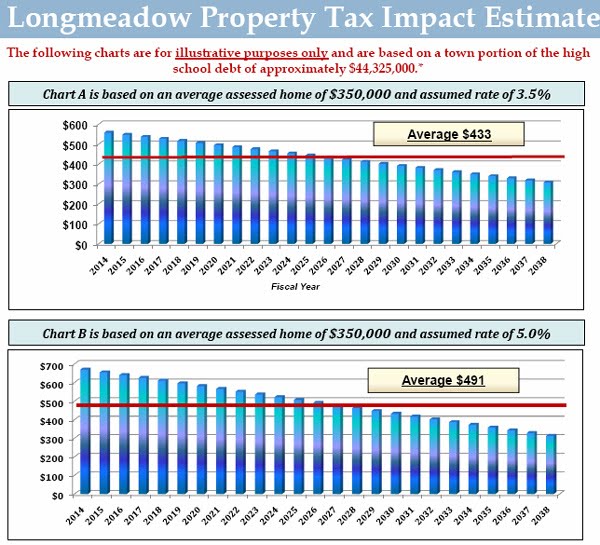
Below is the latest property tax impact analysis by Longmeadow Finance Director, Paul Pasterczyk using the MSBA approved projected building costs and reimbursement information.

[click chart to enlarge]

As I have mentioned in previous posts, the frequently quoted "average property tax increase" over 25 years is not reached until the year 2027- halfway through the life of the 25 year bond. For most home owners, the first full year property tax increase (FY14) as well as the first five years property tax increases are probably more important- not the average over 25 years.

Below is a summary of key information derived from the above graphs.

[click table to enlarge]

The above table for Chart A shows that the first year (FY14) property tax increase is 29% higher and the 1st 5 year average is 22% higher than the 25 year average. Similar results are found for Chart B results.

No one knows what the final taxpayer cost will be for this project because of the uncertainty of both interest rates and project building costs. According to the MSBA approval letter, Longmeadow will be granted up to a maximum of $34 million on a total project cost of $78.5 million. If unforeseen construction costs such as unexpected asbestos removal are incurred that are larger than that included with the budgeted contingencies, it is most likely that Longmeadow would have to cover those costs without reimbursement from the MSBA.

At the School Building Public Forum on September 30, I asked Jeffrey Luxemberg of Joslin Lesser & Associates- Owners Project Manager about the impact of unforeseen cost overruns for our high school project. He indicated that such an "overrun is borne by the locality" meaning Longmeadow and that the MSBA will not provide any additional funding. Below is a short video clip of his response.


Up to now I have been a supporter of the new Longmeadow HS but during the recent FY11 budget discussions I have become increasingly concerned about our ability to afford this project without future sacrifices of important town services. You cannot separate operational and capital needs- the money to fund both types comes from the same source- the Longmeadow taxpayer. Next year, there will likely be continuing discussions to reduce or close Storrs Library and the Longmeadow Adult Center and other town services in order to meet the every increasing financial needs of our schools.

I ask every town resident to make a special effort to become better informed about the school building project by attending upcoming public forums and the special town meeting on May 25.

Also, don't forget to learn more about each of the four candidates running for the two seats on the Longmeadow Select Board. The two individuals who are elected will become key players in determining Longmeadow's future.

Mark election day- Tuesday, June 8 on your calendar.

Tuesday, April 13, 2010

A Public Forum on Longmeadow's Financial Crisis

On Monday afternoon I attended a public forum at the Longmeadow Adult Center organized by a group of concerned citizens including Roger Wojcik, Jerry Nolet, Joe Ochuitti and Phil Fregeau. There were a total about 40 people in attendance representing many different constituencies in town.... including three School Committee members/ the School Building Committee co-chair, two Select Board members, a Select Board candidate, numerous senior citizens, pro-school / anti-school, former teachers, ..


The message from the forum organizers was as follows:

Longmeadow is in a Fiscal Crisis!

The cost of our Schools, Public Safety and other Town Services is becoming overwhelming.

  • The School Committee is asking us to take on a $46 million mortgage for a new high school.
  • Longmeadow is obligated to pay $28 million in Other Post Employment Benefits (OPEB) which it does not have.
  • Longmeadow’s buildings, roads and water/sewer systems need over $100 million worth of repairs.
  • Longmeadow’s budget for next year begins to borrow from our last remaining reserve fund.

The organizers were asking for ideas on how the town might make its way through this mine field of future expenses.

The meeting quickly evolved to a “shouting match” debate over the merits and concerns of the proposed $78 million high school building project.

From the prospective of someone who has followed this project and is reasonably knowledgeable about many of the specifics, I found that there was significant misrepresentation and inaccurate information contributed from both sides- particularly with regard to the cost of the new + renovated high school to the average taxpayer.

I have commented in past LongmeadowBuzz postings that the School Building Committee's average tax increase estimate was misleading. A recent summary of the taxpayer cost by Paul Pasterczyk- Longmeadow's Finance Director wherein the annual cost is shown for each of the 25 years of the school project bond is a much better representation. The first full year of project impact in FY14 will increase the average taxpayer's cost by $575 - $700 depending upon prevailing bond interest rates at that time. The average annual increase over 25 years is estimated to be $455 - $516.

Note: These numbers are somewhat high because the project cost to the town is now $44 million vs. the $46.2 million used for Mr. Pasterczyk's analysis.
---------------------------------------------------
Here are some words to describe a large portion of the meeting.....
loud, angry, disrespectful, contentious.....,

I attended this public forum as an observer and not as a participant. I have attended numerous public forums in the past on similar subjects, listened to my fellow neighbors share their views and occasionally added my own comments. With most past forums, I have walked away feeling that the public debate was worthy of our great town….

Monday, I walked away very disappointed that our town has been much more polarized than I had thought, that the intensity of debate had risen dramatically and many of the participants were not listening to the other side. Most concerning was outright disrespect for other people’s opinions and ideas.

I can only hope that this forum is not representative of the debate that will occur between today and election day and that both sides will work together to see our way through the current financial crisis. We need compromise on both sides….. One word that did finally emerge at the end of the forum seemed to suggest what is needed for our town to successfully navigate these difficult times….

BALANCE…. I will expand what this word means in future posts.

Saturday, April 10, 2010

Happy Birthday Vivian!

The Longmeadow News reported on Thursday that town resident Vivian Henschke recently celebrated her 108th birthday!

Congratulations to Vivian!

Vivian is currently the oldest town resident and has had possession of the Golden Cane since it was presented to her in 2003. At that time Bob Lezinski- a former long time town resident and journalist wrote a story about Vivian and the history of the Golden Cane for the Longmeadow Chronicles- a popular feature on our town website.

For those interested in reading more about Vivian in her "younger days", read the article: "Meet Vivian Henschke: Longmeadow's Eldest Citizen"

A couple of years ago I inquired at Town Hall about the Golden Cane and no one seemed to know much about the tradition or even whether or not it still continued. A big thank you to Hope Tremblay and the Longmeadow News for reporting on this great celebration.

In case you missed this week's LN, a copy of the article is shown below:

[click to enlarge]

For other interesting stories about Longmeadow, its citizens as well as its history... check out the Longmeadow Chronicles on the town website.

Saturday, April 3, 2010

A “sign” of things to come….

Annual Town Elections are Tuesday, June 8 and there is an important race for Select Board with two seats being contested by four candidates. The outcome of this SB election will likely be very important with regard to the future of Longmeadow given that 2 out of 5 voting members will be selected. There is also a contest for a School Committee seat. In addition, there is likely to be a ballot question regarding a Proposition 2½ debt exclusion override for the new high school.

See posting on the Longmeadow Community Bulletin Board for additional election race details.

With so much at stake our town could easily become the lawn sign capital of western Massachusetts.


Below is the town bylaw covering the placement of lawn signs in advance of an election.

6-314. Billboards, Signs and Other Advertising Devices
(e) A temporary sign relating to (i) a candidate for public office, or (ii) an issue which will be voted on at a town meeting or election, or (iii) some other issue which may be of general concern, interest or controversy or (iv) a scheduled function, event or activity sponsored by a non-profit organization, may be erected by the owner of property in any zone or by permission of such owner, but subject to the limitations set forth in subsection (c).

(ii) Temporary signs permitted by subsection (e) (i), as limited by section (e) (i), or signs permitted by section (e) (ii) may be erected no sooner than sixty (60) days prior to the election or meeting at which the candidates or issue will be voted on and must be removed no later than two (2) days after such election or meeting.

This means that Friday, April 9 is first day that lawn signs can be placed without violation of our town bylaw.

There have been past town elections that seemed to suggest that the more signs the better since the election would be determined by who had the most signs on the major streets in town. Let’s hope that town voters are smarter than that and will make informed decisions based upon knowledge of the candidates and/or issues rather than relying upon sign counts.

I ask that each election committee for SB and SC candidates and the expected pro/con political action committees related to the new high school project consider limiting the number of signs placed on lawns to 100 or less so our town does not become the lawn sign capital of Western Massachusetts.

Longmeadow is such a beautiful town in the springtime.

Tuesday, March 23, 2010

Longmeadow Select Board Approves FY11 Budget

“At a special board meeting held on March 22, the Longmeadow Select Board approved a town budget of $51,389,100; a reduction of $385,775 from the current year’s spending level. This budget, which reflects a 4% decrease in state aid and the anticipated reduction of other local receipts, will be put before town residents at the Longmeadow Annual Town Meeting on May 11.” [press release, 3/23/10].

The FY11 budget process which has been followed on the Longmeadow Buzz since November when the Tri-Board (School Committee, Select Board and Finance Committee) met has been very difficult. Many budget cuts have been proposed and then restored by both the School Committee and Select Board after careful analysis and feedback from public forums. During this budget process a Select Board initiative toward creating a more sustainable budget was not very successful and next year’s budget will likely meet similar difficulties.

Below are a few short video clips (courtesy of LCTV) from last night’s special SB meeting which provide an overview of various SB member’s positions on the current budget.

The first video clip is Mark Gold explaining his proposal to balance the budget while maintaining as many important town services as possible. His long hours of work to “drill down” into the budget details with Finance Director Paul Pasterczyk, Town Manager Robin Crosbie and others were key to achieving the balanced budget that was approved at last night’s SB meeting.


The second clip is Rob Aseltine “thanking” Mark Gold for diligent work but stating he could not support the budget as proposed because there were insufficient cuts in town side headcount and services and that it did not meet what he felt was the desired sustainability requirement. Without additional town side cuts, the school dept would be severely impacted with their increasing technology and curriculum needs. In this video clip, Mr. Aseltine also suggested that after the June election when the “new board is constituted”, he will launch an important initiative to reduce the town side cost of doing business.


In the next clip Mark Gold provides some additional thoughts on the FY11 budget.


Robin Crosbie- Town Manager shares her thoughts on the issue of “comparable cuts” in budget items. Rob Aseltine had challenged the TM and the SB many times in the past few months suggested that there were insufficient town side headcount reductions as compared to the School Dept. proposal.


This next short clip is Paul Santaniello summarizing his thoughts on the FY11 budget.


The final video clip is that of SB Chair Bobby Barkett commenting on the FY11 budget and expressing some significant reservations that the desired “restructuring” of town government was not achieved and fearing that the state legislature may impart some mid-fiscal year cuts that could be very difficult for our town finances to absorb.


The final vote on the FY11 budget was 3-2 with Gold, Santaniello and Scibelli in favor and Aseltine and Barkett opposed.

Tuesday, March 16, 2010

Small Town Candidates and Big-Time Politics


The popular caricature of a glad-handing, back slapping, puddle-deep, politician is ubiquitous in American politics. The relationship between actual politicians and the voters, however, seems to belie this very popular and intentionally pejorative stereotype. In “real life” it often seems like the politicians who most resemble this picture are also the most effective policy makers. This realization tends to amplify another popular notion, namely that big-time politics and policy making are corrupt, superficial, and not attractive to folks who are willing and able to “roll up their sleeves, work hard, and do the right thing even when it’s unpopular.”

Click HERE for the rest of the story.

An Important Election Season


The following nomination papers have been certified for the Town of Longmeadow Annual Town Election to be held on June 8, 2010.


Select Board – 2 three year seats
:
Roy Johansen, 85 Western Drive
Mark Gold, 129 Avondale Road (Incumbent)
Michael Clark, 169 Cooley Drive
Christine Swanson, 96 Salem Road
David Gustafson, 173 Ardsley Road

School Committee – 2 three year seats:
Thomas Brunette, 187 Quinnehtuk Road (Incumbent)
Tracy DeMarco, 152 Meadow Road
Jennifer Jester, 129 Farmington Avenue

Planning Board – 1 five year seat
Kenneth Taylor, 149 Academy Drive (Incumbent)

****At this time the town will need to hold a preliminary election for the two Select Board seats to narrow the field of five candidates down to four on Tuesday, May 4 from 8 am – 8 pm, unless any candidate withdraws their name. The deadline to file objections or withdrawals is March 31 at 5 PM.

Annual Town elections will be held on Tuesday, June 8.

At this election will likely be a vote on a debt exclusion Proposition 2½ override of ~ $46 million for the new high school and the election of two Select Board members who will likely be very influencial regarding the future direction of our town.

It's now the time for town residents to wake up and become informed.

Saturday, March 13, 2010

Longmeadow Residents Speak Out

The public forum last Tuesday night (March 9) at Longmeadow HS on the proposed FY11 budget was a chance for town residents to provide some guidance to the Select Board as they make the necessary final FY11 budget cuts. At this meeting town residents provided balanced feedback citing the importance of schools, library, parks and recreation programs, senior center, police/ fire.... not wanting cuts from any of these important town programs.

Below are a couple of video clips (courtesy of LCTV) of comments made by town residents expressing their concern for cuts in various programs. [A web rebroadcast of the entire public forum is posted on LCTV's website.]

The first video shows town resident Jamie Cass- a Springfield teacher commenting on the town’s outstanding Parks and Recreation program and the Storrs Library and asks that the Select Board not cut funds to either program.


The second video is town resident Irene Madden- a career school librarian and Storrs Library board member overviewing all of the many programs provided by the Children’s Library staff.


The third video clip shows town resident Saul Finestone appealing to the Select Board not to cut the Longmeadow Adult Center budget because of all the important programs that it provides for senior citizens in our town.

_________________________________________________________

I think that it's important to understand that there have been many more cuts proposed than will likely be needed to create a balanced FY11 budget. The ongoing budget discussions involve identifying potential budget cuts and then prioritizing them.

The latest information yesterday from the state legislature recommended that towns prepare for a 4% maximum cut in local aid. This should provide some relief for the FY11 budget and allow the Select Board to restore some of the proposed budget cuts.

The Select Board has another goal and that is to create a "sustainable budget" so the current fiscal problems do not reappear year after year. "Our expenditures are too high and the rate of increase too great to be sustainable and must be reduced." This message is repeated at virtually every SB meeting since November. It will be very interesting to see how budget process ends up... it is the not the first time that our town leaders have tried to tackle the imbalance of expenditures vs. revenue growth.

It is not too late to provide your inputs to the Select Board regarding proposed program cuts in the FY11 budget. The Select Board will meet again on March 15 to discuss the budget and there is a public comment period at the beginning of the meeting.

On March 22 the SB will approve the final FY11 budget (town + schools) to be presented at the Annual Town Meeting on May 11.

Tuesday, March 9, 2010

A New High School…Finally

I am a retired music teacher who lives in Longmeadow. My great grandfather, grandfather, and father taught me what they knew best, the building trade. They built homes featured in Better Homes and Gardens for Mike Wallace and Ginger Rogers. They also built churches and schools for more than 80 years.

Longmeadow High School was built nearly 60 years ago. In response to Leo Vartanian’s Reminder article, a school is not at all like a personal residence. It’s building, design, maintenance and use are all different. Most folks today don’t spend 60 years in a home. A school facility plays host to thousands of students, as well as hundreds of parents and community events. Many school buildings are seeing an expanded role for the future.

I came to Longmeadow in 1973 and entered a “newly renovated” room. My dad and I looked at the work and contacted officials to have many things changed or corrected. Unfortunately little was ever substantively changed and I worked in this facility for the next 35 years. For example, a door designed for the purpose of moving the piano on and off the stage was 2” too small. The crumbling asbestos covering a pipe in the music lab would stay in place until 8 years ago when a parent finally demanded its removal.

During my tenure, the music program grew to number almost half of the high school population. We were recognized with several Grammy and other awards for excellence. Our auditorium remains one of the poorest in the region from every perspective. It has only 614 seats and a small stage that doesn’t really accommodate some of our groups. Our local fire department has asked us to limit the enthusiast attendance at our concerts because the facility is too small it and can create an unsafe situation. The inadequate ventilation can be louder than the music and therefore is best when turned off. Our seats, finally recovered by the Hampden County Jail inmates a few years back, still feature an “individual broken spring massage” which make them difficult to sit in for very long. The lighting was finally replaced when a school committee person’s daughter was nearly electrocuted. The new lighting board was replaced with the cheapest available board and only functions nominally.

As a past Department Chair and Coordinator of Music grades K-12, I also respect the fact that the other departments have similar stories to tell. The science lab situation is one good example.

Longmeadow real estate has maintained its value for many reasons, not the least of which has been the reputation of the schools. The excellent teachers, motivated students, and successful parents are responsible for this continued success, despite the conditions of the facilities, books and equipment. Successful private industry looks to improve its tools and facilities to maximize the results. Shouldn’t education do the same? Imagine the new standards that we could establish at the high school with better conditions.

Each year we are told of economic hard times and uncertainty. This has been the consistent story since 1981, although it has not always been true. This year it is the truth and the town’s operating budget reflects that fact. The music department’s string program was reduced last year and may be eliminated in this budget. Is this the price of excellence?

The new school is a capital improvement that will be paid for over a long period of time and contribute to our community for the next 60 years. It is fiscally wise to separate your yearly operating budget from long-range capital improvements. I also understand that a negative vote on this school will put us at the end of the reimbursement line for as much as ten years. Can Longmeadow afford that? Mr. Vartanian suggests that we consider spending the money as though it is our own, and I agree. We sent this money to Boston in our taxes and fees. Let’s be smart and reclaim our money though the 30 to 40 million-dollar reimbursement a new school will yield. Vote for the new school that our kids and town both need and deserve.

Peter Thomsen
Longmeadow, MA