Thursday, April 29, 2010

Our Infrastructure

"What does the Town of Longmeadow do for preventative maintenance on sewers and water mains?" I asked a former member of the Water and Sewer Commission back in 2003, during a Charter Commission meeting. The town was investigating whether the structure of government was helpful in meeting town needs or was causing problems. The answer we received, that there was no preventative maintenance, surprised me. Who would think that this gem of towns in western Massachusetts had a flaw so deep inside?

That was one problem. There were several others. The town ultimately voted to restructure government so that it would more easily attend to residents' needs. It is not perfect; indeed, there may be no such thing as an ideal fix. But we can see evidence of improvement in maintenance of town resources, especially in the process used for the proposal to solve the problem that is our high school.

In particular, residents need to know about "The Maintenance Factor" as Director of Public Works & School Building Committee member Michael Wrabel puts it.

What does he write of the existing HS building?
"Mechanical, electrical and plumbing systems (MEP) and Heating, ventilation and air conditioning systems (HVAC) are showing their age. Components have been out of service and have adverse affects on the building and the everyday users of the high school.

Steam lines that are in mechanical chases or tunnels under the building are degrading and leaking. Access for repair is difficult and often requires asbestos abatement work prior to the mechanical repair being completed.

In 2009 a broken steam line that crosses a courtyard from one addition to another ruptured and required partial replacement. Access to the courtyards for excavation is non-existent for excavation equipment and repairs were expensive to perform.

Plumbing drain lines that were installed in the 1950’s become blocked and at times requires breaking of a concrete floor for access to permit repairs.

Air handlers, blowers, heating and cooling coils, all parts of the HVAC system constantly require service because of their age in spite of routine preventive maintenance that is performed on them."

Further, he adds:

"Replacement of this tired and out-dated facility with a modern structure will enhance the ability of custodial and maintenance staff to perform routine duties.
Building energy efficiency will be increased and capital project spending will be decreased for the next 10-15 years if this project receives approval from the residents.

Longmeadow takes pride in the educational system and this upgrade to the cornerstone of the educational system will be a source of pride to residents for many years to come." (emphasis mine)

As someone (on the Housing Authority) who is keenly aware of residents' housing needs (and is working to improve the situation for those who are struggling financially), and as someone who has been aware of the ENTIRE TOWN's infrastructure needs for several years, I am in favor of the High School proposal. It will contribute to a much better Longmeadow, one that benefits all residents.
Rebecca M. Townsend

Wednesday, April 28, 2010

Response to Jim Moran & Call for Wojcik’s Resignation

Unfortunately, the necessary corrections to Jim Moran’s latest post were too extensive to put them all in comments to his post.

Jim’s effort to question the relevance of my statement regarding the fact that the high school project is a capital budget expense and the library operation is an operating budget expense is wrong headed. Apparently, Jim was fooled by Mr. Wojcik’s rhetorical sleight of hand. Mr. Wojcik conflated the principle and interest payments (which do happen annually) with operating expenses like library operations as if the cost of one would be necessarily pitted against the cost of the other. The fact that there is absolutely no credible evidence to suggest this scenario, and that it is based on cherry picked assumptions, clearly complicates Mr. Wojcik’s efforts to frighten library patrons into cutting off their noses to spite their faces.

Jim also writes, “Mr. Duquette’s approach is similar to many new HS school building advocates who have simply decided that to ignore or discount or discredit mention of the any other financial needs of the town and want to simply move forward and build the new high school. They do not want to discuss the financial ability of Longmeadow’s town residents to support such a project.”

This is particularly disappointing commentary given Jim’s dedication to keeping up with issues in our town. His work in this regard is tremendously valuable. But this analysis is way off the mark. No one has ignored or discredited mentions of other capital needs in town, in fact during the exhaustive process of working toward the new high school virtually every elected official in town solicited opinions about the town’s priorities. Indeed, the elected officials who support the high school project are also the officials most acutely aware of our budgetary and capital needs issues. The arguments of Messrs Wojcik and Nolet have been heard and debated ad nauseum. Their credibility at this stage requires the belief that our elected officials are either incompetent, corrupt, or both, and that is simply beyond the pale.

The idea that supporters have simply rammed through the high school project without regard for the opinions of those who have different priorities is cynical and wrong. Essentially, Mr. Wojcik and company simply lost the priorities debate on the merits, something made blatantly obvious by the desperate nature of their “argument” against it now.

Wojcik tried to argue that we can’t afford a new High School as if we haven’t spend the last year carefully weighing the manner in which we were going to upgrade a high school that presently violates any number of building code requirements and has failed to keep up with the requirements of properly educating our children. He also seems oblivious to the fact that the present project is a hell of a good deal that will never get cheaper. He wants folks to believe that all the other town needs will fall by the weigh side if we build a new high school and yet he has never even presented an alternate vision of the town’s priorities placing something else in front of the high school.

Wojcik and company argued that we could renovate for less. They were proven wrong on that. They cherry picked a claim from an old study that seemed to imply the feasibility of cheaper renovation, ignoring the finding of that same study which strongly recommended building new. At every step of the way these “concerned citizens” had their concerns proven unwarranted and now they are simply throwing every possible argument against the wall and praying that something sticks.

So what was left of Wojcik’s arguments last night? He put some old wine in slightly new bottles, primed the audience's economic anxiety and fear of the unknown, and then tried to slip in his “Hail Mary” pass – that our Select Board and School committees want to commit all of our resources to the schools and close the Storrs library. For Wojcik, its really all about stopping our elected officials from building a Taj mahal for their kids on the backs of Longmeadow’s hard working folks without kids in the school. Incidentally, both pro and anti school factions in our town have parents and empty nesters aplenty. Short sightedness is not an age-related disability. The effort to construct an "us versus them" narrative along generational lines is just a cynical ploy intended to maximize emotional reactions.

Jim Moran is one of our town’s most valuable civic assets and I have tremendous respect for what he does and usually how he does it, but I think he might have gotten too close to some folks on this one and lost his perspective. He thinks that high school supporters like me “do not want to discuss the financial ability of Longmeadow’s town residents to support such a project.” We’ve been discussing that very thing all along. If we use Mr. Wojcik's budgetary assumptions we'd have to conclude that our town can never afford to do anything, which of course is the conclusion his chosen assumptions were designed to encourage.

The fact is that the people who understand that schools are our town’s most valuable asset are the majority of the folks who do all the work and show up to all the meetings and sacrifice massive amounts of their time to run for and serve on town government boards and committees. The proud few like Wojcik, who are very active in town but do not share this view of our priorities are understandably frustrated about their inability to win arguments in our participatory political process, but that’s no excuse for dishonesty and fear mongering. Their efforts to incite the anger of voters who are not engaged in, or knowledgeable about the town's affairs is shameful. Frankly, I cannot understand how anyone can put much stock in Mr. Wojcik’s “budgetary analysis,” which several audience members clearly debunked during the meeting last night, given his shameful efforts to exploit the fears of residents and to smear the good names of public officials that have given him every opportunity to make his case and who have earned the respect and admiration of all of our town’s residents.

I think residents of good will should demand the immediate resignation of Mr. Wojcik from the town’s Finance Committee. His distorted budgetary analysis makes him unqualified for that job and his baseless attacks on the integrity of our elected officials makes him unfit for public office.

Citizens for A Better Longmeadow

is the name of the group led by Roger Wojcik that organized a “public” forum that was attended by an overflow crowd of ~ 65-70 people last night at Storrs Library. The meeting objective as outlined at the outset by Mr. Wojcik was to provide some factual information about the financial issues facing the town both today and into the future. This group believes that many town residents need additional information to make informed decisions at the upcoming town meetings on May 11 and May 25 as well as town elections on June 8. Mr. Wojcik asked attendees to be respectful to each other and not have a repeat of the April 12 forum.

First of all, I applaud Mr. Wojcik’s attempt to provide some factual information about town finances including both the town’s annual operating and capital budgets as well as some of the other current liabilities such as Other Post Employment Benefits (OPEB). In addition to being a member of the town’s Finance Committee and a past member of the Capital Planning Committee, Mr. Wojcik has useful workplace experience in developing and managing corporate budgets. During the meeting Mr. Wojcik was criticized a number of times by some attendees, particularly about the accuracy of a $35 million OPEB future liability but he pointed to an official town analysis by Scanlon & Associates as his source. Similar objections were voiced about a report on town infrastructure problems and there were attempts by some attendees to discredit this information as well.


Other than one flamboyant outburst by a well-known town resident and regular poster on this blog, the meeting proceeded with a reasonable decorum- far better than the previous forum on April 12 (see my previous post)…. that is, until Mr. Wojcik turned the meeting from an information session into a political debate about Select Board candidates for the upcoming election and the inadvisability of electing former/ current School Committee members to the Select Board. What followed was not unexpected from my vantage point given the makeup of the audience.... the meeting turned into a similar “shouting match” situation as did the April 12 forum and the meeting ended on a very sour note….

Regarding Mr. Duquette’s latest post here on the Buzz blog…

I have listened and attended numerous Select Board/ School Committee meetings as well as official public forums on the current school/town budgets and high school building project during the past 9 months. I believe that I understand the situation quite well and have become very concerned about where we are headed.

Mr. Duquette makes the following statement in his latest Buzz post…

“The library is an operating expense, while the new high school is a capital expense. Closing the library doesn’t do anything to advance the high school project.”

He also states that Mr. Wojcik would have “earned a poor grade in my public budgeting course”. During the meeting Mr. Duquette also restated his recurring theme that “you can’t run public government like a business”.

As Mr. Wojcik tried to explain at last night’s meeting, a capital expenditure turns immediately into an line item operating expense through annual repayment of interest + principal. For the proposed high school project this operating budget line item is likely to be ~ $3.5 – 4.0 million in FY2014 (based upon estimates by Paul Pasterczyk- Town Finance Director but actual numbers are dependent upon municipal bond interest rates). (See my recent post to determine individual property tax impact.)

Mr. Duquette’s approach is similar to many new HS school building advocates who have simply decided to ignore or discount or discredit mention of the any other financial needs of the town and want to simply move forward and build the new high school. They do not want to discuss the financial ability of Longmeadow’s town residents to support such a project.

I believe that we are making a mistake if we simply choose to ignore Longmeadow’s other financial issues as we debate the decision to build a new high school. Given our difficulties in formulating the FY11 budget, it is clear that we will be making additional difficult choices in the very near future… not necessarily ones that we want to make but ones that we are forced to make. These unpopular choices may include reductions in teachers, fire dept/ police dept staff, additional curtailment of library services ……

Our town leaders need to BALANCE available financial resources to deliver both school and town services so that all segments of our town population are treated fairly. With two seats (out of 5) on the Longmeadow Select Board being decided at the June 8 election, it is important for town voters to fully understand each candidate’s position on this issue so that they can make right choices.

Tuesday, April 27, 2010

The Concerned Citizens Public “Fraudum”

WARNING: The following was written while angry and despite being accurate, it flatly contradicts sound political advice dispensed by the author (i.e. me) in an earlier LongmeadowBuzz post. The author, and only the author, is responsible for the content and tone of this analysis.


Tuesday night, I attended a “public forum” conducted by a group of Longmeadow residents calling themselves “Concerned Citizens of Longmeadow.” The purpose of this group is to oppose the construction of a new high school, a question that will be decided by the voters this spring. While there is an argument to be made about whether or not the high school is our highest and most urgent priority, these “concerned citizens,” represented by town elder Roger Wojcik, have decided not to make such an argument.

Apparently, unwilling to admit that his group considers our schools to be lower on the priority list of town services than such things as reserve funds and infrastructure repairs, Wojcik used his “public forum” to paint pessimistic pictures of the town’s budget and the funding of future employee benefits obligations, both based on dubious interpretations of available data. While these arguments were weak, at least they were debatable. As the meeting progressed, however, it became clear that the primer on public finance (which sadly would have earned Mr. Wojcik a poor grade in my public budgeting course) was mere prelude to the group’s real purpose, which was to generate opposition to the new high school project by convincing voters that it is much too expensive and, more importantly, that it’s also a pet project of town elected officials engaged in a conspiracy to improve the schools at the expense of other town services.

I briefly wondered if Wojcik was going to claim that these selfish pro-schoolers intended to ration services to the town’s elderly in order to pay for their wasteful give-aways to the town’s school children. No ambulance service to folks over 80! If you “fall and can’t get up” don’t bother calling 911 grandma because the selfish pro-schoolers took away the money to respond to your distress call! But I digress…

What support did Mr. Wojcik have for this attack on the integrity of our elected officials? I kid you not, he actually attempted to validate his conspiracy theory by claiming that “rumor has it” some of the members of the Select Board want to close Storrs Library. Note to aspiring demagogues: when you try to scare voters away from proposals you can’t discredit legitimately don’t use accusations that are INCREDIBLY COUNTER-INTUITIVE, like that one of the elected supporters of the new high school project has publicly stated that he “has no use for the library.”

There are two reasons why this scare tactic via personal attack is silly. First, the Select Board member so accused is a university professor. The annual convention of university professors willing to close public libraries could be held under a tent made from a single pair of Rush Limbaugh’s pants. Second, the library is an operating expense, while the new high school is a capital expense. Closing the library doesn’t do anything to advance the high school project.

Essentially, Wojcik wants voters to believe that these evil former School Committee members on the Select Board have skillfully duped voters into electing them so they can siphon funds from non-school town services and build an unnecessarily expensive new high school... and a couple of them may have been born in Kenya. (Sorry, I couldn’t resist) At the very same time, inexplicably, he also expects us to believe that these folks are dumb enough to seriously advocate closing the Storrs Library. What these “concerned citizens” apparently hoped was that fearful library patrons (apparently without a penchant for logic or common sense) would be inclined to oppose the new high school just to spoil those anti-library former school committee members’dastardly plans.

I’m telling you, this guy was starting to make Glenn Beck look clever by comparison. He tried to put forth a sort of principled objection, though not to the new high school. Instead, he tried to bolster his School Committee takeover of the town conspiracy theory with a plea for voters to apply a form of “checks and balances” in the voting booth this spring by rejecting the Select Board candidacy of present School Committee women Christine Swanson. In addition to further reducing his intellectual credibility by badly misconstruing the notion of "checks and balances" in his efforts to justify a baseless smear of a highly capable member of our town's elected leadership, Wojcik managed to put the last nail in the coffin of his integrity as well, thanks to an audience member who served with Wojcik on the town’s last Charter Commission who essentially hoisted him on his own petard by recalling for the audience that Mr. Wojcik had explicitly endorsed the usefulness of joint membership on the Select Board and the School Committee during the recent Charter Review process, and asking point blank why he has reversed himself on that point. His failure to offer an audible response was deafening.

Bottom-line: These “concerned citizens,” having exhausted their legitimate, though relatively weak, arguments against the new high school, took a page right out of the Karl Rove playbook and are mounting a distract and confuse campaign featuring personal attacks on the integrity of the elected officials who are supporting the new high school project. The fact that the project resulted from a very comprehensive, transparent, and deliberative decision making process is something these “concerned citizens” must downplay as much as possible if they are going to have any chance of getting voters to oppose the project. The hope of such tactics is to generate fear and loathing enough to trick low information voters and provide a handy rationalization for a vote against the high school project by their fellow flat earthers and anti-tax zealots.

Personally, I like to refer to these perennial opponents of the schools as the “I appreciate the value of education as much as anyone, but…” crowd. My advice to voters; ignore the soap opera, conspiracy theories, and the competition for who can be most offended, and ask yourself if schools are an important enough priority for our town to invest in a new high school right now. If, like me, you believe that high quality public schools are an irreplaceable component of a high value town, and that opportunities to undertake such improvements don't come along very often or with as much state funding assistance as this project has attracted, then a vote for the new high school is something to strongly consider.

Sunday, April 25, 2010

Longmeadow group opposes proposed new high school

This morning’s Sunday Republican newspaper (4/24/10) contained an article entitled “Group Opposes School Building” – click here to read complete story on MassLive.


The group calling themselves “Citizens for a Better Longmeadow” voiced their concern to the Springfield Republican editorial board about the wisdom of spending $78 million building a new high school given the significant financial difficulties that are ahead for the town of Longmeadow. They believe a more “fiscally responsible” and lower cost renovation project would be in the best interest of the town. This group- led by Roger Wojcik, Philip Fregeau and Gerald Nolet have been holding “public forums” to express their concerns.

Their next forum is scheduled for Tuesday, April 27 at 6:30 PM at the Storrs Library/ The Betty Low Room.

Hopefully, the discussion will be more reflective of our town’s character and not resemble the last public forum on April 12 about which I wrote a Buzz posting that was largely a shouting match between the opposing sides in this debate.

Sunday, April 18, 2010

The New High School Project


The debate over the wisdom of the new high school project looks very familiar in two fundamental respects. First, the leaders of both sides in this debate are the “usual suspects.” Supporters are led by the town’s elected leaders, who have approached the issue with committees, studies, hearings, and sundry other systematic and careful processes. The opponents are led by the very same people who oppose every proposal that would, or even could, increase local taxes. Second, the opponents’ argument is heavily reliant on questioning the motives, integrity, and even the intelligence of the proponents, while proponents have relied “mostly” on verifiable evidence and careful rational planning. It’s a classic “analysis versus attack” or “policy versus politics” battle in which one side has a decided advantage when the debate focuses on facts, data, and relevant evidence; while the other side’s only viable strategy at this point is to frame the question in motivational and personal terms; to make it an “us versus them” affair.

Those of us who understand and agree with the evidentiary case of proponents, despite the very real and not inconsiderable financial costs, must proceed soberly and wisely in the run up to the election that will help decide the matter. It is very easy to slip into the same mode as the loudest opponents of school improvements. Avoiding personal recriminations in the face of constant, repetitive, personal attacks, misinterpretations, and baseless claims requires the patience of Job. However, when we fail to resist the impulse to “fight fire with fire” we unintentionally help opponents burn down the house. When supporters of good government attack anti-tax, anti-government ARGUMENTS, they must try to be clear about the targets of their rhetorical arrows – the ARGUMENTS, not the arguers.

When supporters of sound policy proposals carelessly neglect the difference between anti-school motives and anti-school arguments, they unintentionally strengthen the otherwise baseless claims of their opponents by giving them grounds to “be offended.” Every voter compelled to include any personal slights in their calculations (i.e. all of us) is a voter that might be unduly swayed by attacks over analysis. Even trying to turn the “umbrage” tables on opponents who traffic in attacks over analysis unintentionally validates this counter-productive frame of reference. Like it or not, every one of us responds to emotional appeals. Every one of us, no matter how schooled or how disciplined, is incapable of totally excluding non-rational factors from our analysis. We are all susceptible to being manipulated by non-rational arguments.

In the argument over the new high school, every reasonable question asked about the project has been answered, along with several unreasonable questions. The real costs of the new high school have been well chronicled, particularly here on LongmeadowBuzz. Reasonable arguments for and against the project are in place and will likely produce a victory for the project at the polls. The only viable strategy left for opponents is to deflect attention from sound analysis onto their personal political narrative in which brave, honest, hard working taxpayers are standing up to the “political elites” in town, who want to drive the elderly residents “on fixed incomes” out of town so that more elitists can move in and further drive out middle income residents. While this looks silly on paper and is immune to credible verification, it can move voters whose attention to local politics is neither focused nor frequent. It also works quite well as a rallying cry for those whose attention is quite focused and frequent, but whose inclination is to oppose the project.

You need look no further than the latest mass movement in American politics, the so-called Tea Party movement, for a clear example of this phenomenon. Whenever specific policy arguments are engaged, the Tea Party perspective looks ridiculous, but when the “us versus them,” or “average Joes versus elites” narrative is combined with classic American ideological rhetoric (i.e. “don’t tread on me,” etc…) the movement preserves its appeal.

When push comes to shove in our debate over the new high school, proponents simply must “turn the other cheek” and be just as repetitive and persistent in citing the facts and evidence as opponents are in trying to goad supporters into validating their “us versus them” narrative. Political success requires us to stick to the issues and to confine any and all personal or emotional claims to “positive” ones. At this point, negativity and neglect of the relevant information are the only things standing in the way of this important project.

Friday, April 16, 2010

School Building Cost and Taxpayer Impact

Estimated property tax increases for the new high school project continue to be publicized by the School Building Committee in the media as the "average" over 25 years.

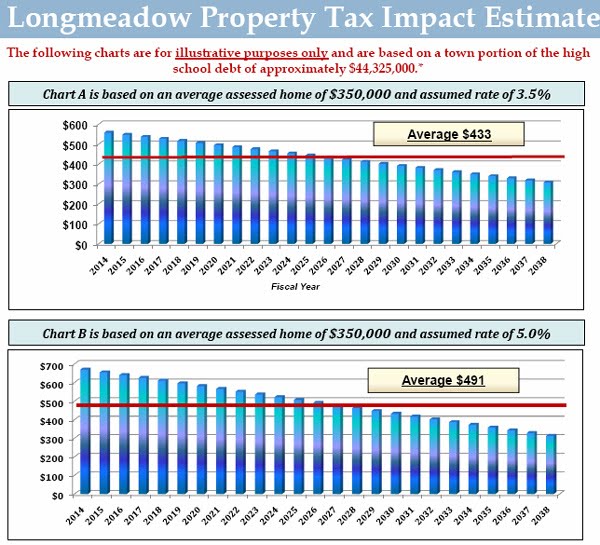
Below is the latest property tax impact analysis by Longmeadow Finance Director, Paul Pasterczyk using the MSBA approved projected building costs and reimbursement information.

[click chart to enlarge]

As I have mentioned in previous posts, the frequently quoted "average property tax increase" over 25 years is not reached until the year 2027- halfway through the life of the 25 year bond. For most home owners, the first full year property tax increase (FY14) as well as the first five years property tax increases are probably more important- not the average over 25 years.

Below is a summary of key information derived from the above graphs.

[click table to enlarge]

The above table for Chart A shows that the first year (FY14) property tax increase is 29% higher and the 1st 5 year average is 22% higher than the 25 year average. Similar results are found for Chart B results.

No one knows what the final taxpayer cost will be for this project because of the uncertainty of both interest rates and project building costs. According to the MSBA approval letter, Longmeadow will be granted up to a maximum of $34 million on a total project cost of $78.5 million. If unforeseen construction costs such as unexpected asbestos removal are incurred that are larger than that included with the budgeted contingencies, it is most likely that Longmeadow would have to cover those costs without reimbursement from the MSBA.

At the School Building Public Forum on September 30, I asked Jeffrey Luxemberg of Joslin Lesser & Associates- Owners Project Manager about the impact of unforeseen cost overruns for our high school project. He indicated that such an "overrun is borne by the locality" meaning Longmeadow and that the MSBA will not provide any additional funding. Below is a short video clip of his response.


Up to now I have been a supporter of the new Longmeadow HS but during the recent FY11 budget discussions I have become increasingly concerned about our ability to afford this project without future sacrifices of important town services. You cannot separate operational and capital needs- the money to fund both types comes from the same source- the Longmeadow taxpayer. Next year, there will likely be continuing discussions to reduce or close Storrs Library and the Longmeadow Adult Center and other town services in order to meet the every increasing financial needs of our schools.

I ask every town resident to make a special effort to become better informed about the school building project by attending upcoming public forums and the special town meeting on May 25.

Also, don't forget to learn more about each of the four candidates running for the two seats on the Longmeadow Select Board. The two individuals who are elected will become key players in determining Longmeadow's future.

Mark election day- Tuesday, June 8 on your calendar.

Tuesday, April 13, 2010

A Public Forum on Longmeadow's Financial Crisis

On Monday afternoon I attended a public forum at the Longmeadow Adult Center organized by a group of concerned citizens including Roger Wojcik, Jerry Nolet, Joe Ochuitti and Phil Fregeau. There were a total about 40 people in attendance representing many different constituencies in town.... including three School Committee members/ the School Building Committee co-chair, two Select Board members, a Select Board candidate, numerous senior citizens, pro-school / anti-school, former teachers, ..


The message from the forum organizers was as follows:

Longmeadow is in a Fiscal Crisis!

The cost of our Schools, Public Safety and other Town Services is becoming overwhelming.

  • The School Committee is asking us to take on a $46 million mortgage for a new high school.
  • Longmeadow is obligated to pay $28 million in Other Post Employment Benefits (OPEB) which it does not have.
  • Longmeadow’s buildings, roads and water/sewer systems need over $100 million worth of repairs.
  • Longmeadow’s budget for next year begins to borrow from our last remaining reserve fund.

The organizers were asking for ideas on how the town might make its way through this mine field of future expenses.

The meeting quickly evolved to a “shouting match” debate over the merits and concerns of the proposed $78 million high school building project.

From the prospective of someone who has followed this project and is reasonably knowledgeable about many of the specifics, I found that there was significant misrepresentation and inaccurate information contributed from both sides- particularly with regard to the cost of the new + renovated high school to the average taxpayer.

I have commented in past LongmeadowBuzz postings that the School Building Committee's average tax increase estimate was misleading. A recent summary of the taxpayer cost by Paul Pasterczyk- Longmeadow's Finance Director wherein the annual cost is shown for each of the 25 years of the school project bond is a much better representation. The first full year of project impact in FY14 will increase the average taxpayer's cost by $575 - $700 depending upon prevailing bond interest rates at that time. The average annual increase over 25 years is estimated to be $455 - $516.

Note: These numbers are somewhat high because the project cost to the town is now $44 million vs. the $46.2 million used for Mr. Pasterczyk's analysis.
---------------------------------------------------
Here are some words to describe a large portion of the meeting.....
loud, angry, disrespectful, contentious.....,

I attended this public forum as an observer and not as a participant. I have attended numerous public forums in the past on similar subjects, listened to my fellow neighbors share their views and occasionally added my own comments. With most past forums, I have walked away feeling that the public debate was worthy of our great town….

Monday, I walked away very disappointed that our town has been much more polarized than I had thought, that the intensity of debate had risen dramatically and many of the participants were not listening to the other side. Most concerning was outright disrespect for other people’s opinions and ideas.

I can only hope that this forum is not representative of the debate that will occur between today and election day and that both sides will work together to see our way through the current financial crisis. We need compromise on both sides….. One word that did finally emerge at the end of the forum seemed to suggest what is needed for our town to successfully navigate these difficult times….

BALANCE…. I will expand what this word means in future posts.

Saturday, April 10, 2010

Happy Birthday Vivian!

The Longmeadow News reported on Thursday that town resident Vivian Henschke recently celebrated her 108th birthday!

Congratulations to Vivian!

Vivian is currently the oldest town resident and has had possession of the Golden Cane since it was presented to her in 2003. At that time Bob Lezinski- a former long time town resident and journalist wrote a story about Vivian and the history of the Golden Cane for the Longmeadow Chronicles- a popular feature on our town website.

For those interested in reading more about Vivian in her "younger days", read the article: "Meet Vivian Henschke: Longmeadow's Eldest Citizen"

A couple of years ago I inquired at Town Hall about the Golden Cane and no one seemed to know much about the tradition or even whether or not it still continued. A big thank you to Hope Tremblay and the Longmeadow News for reporting on this great celebration.

In case you missed this week's LN, a copy of the article is shown below:

[click to enlarge]

For other interesting stories about Longmeadow, its citizens as well as its history... check out the Longmeadow Chronicles on the town website.

Saturday, April 3, 2010

A “sign” of things to come….

Annual Town Elections are Tuesday, June 8 and there is an important race for Select Board with two seats being contested by four candidates. The outcome of this SB election will likely be very important with regard to the future of Longmeadow given that 2 out of 5 voting members will be selected. There is also a contest for a School Committee seat. In addition, there is likely to be a ballot question regarding a Proposition 2½ debt exclusion override for the new high school.

See posting on the Longmeadow Community Bulletin Board for additional election race details.

With so much at stake our town could easily become the lawn sign capital of western Massachusetts.


Below is the town bylaw covering the placement of lawn signs in advance of an election.

6-314. Billboards, Signs and Other Advertising Devices
(e) A temporary sign relating to (i) a candidate for public office, or (ii) an issue which will be voted on at a town meeting or election, or (iii) some other issue which may be of general concern, interest or controversy or (iv) a scheduled function, event or activity sponsored by a non-profit organization, may be erected by the owner of property in any zone or by permission of such owner, but subject to the limitations set forth in subsection (c).

(ii) Temporary signs permitted by subsection (e) (i), as limited by section (e) (i), or signs permitted by section (e) (ii) may be erected no sooner than sixty (60) days prior to the election or meeting at which the candidates or issue will be voted on and must be removed no later than two (2) days after such election or meeting.

This means that Friday, April 9 is first day that lawn signs can be placed without violation of our town bylaw.

There have been past town elections that seemed to suggest that the more signs the better since the election would be determined by who had the most signs on the major streets in town. Let’s hope that town voters are smarter than that and will make informed decisions based upon knowledge of the candidates and/or issues rather than relying upon sign counts.

I ask that each election committee for SB and SC candidates and the expected pro/con political action committees related to the new high school project consider limiting the number of signs placed on lawns to 100 or less so our town does not become the lawn sign capital of Western Massachusetts.

Longmeadow is such a beautiful town in the springtime.